 Leaves of Learning
Classes, Schedules, & Schedule Planners
Choose classes with your student, compare the time commitment, and build a weekly plan that fits.
Planning Resources
Start with the schedules
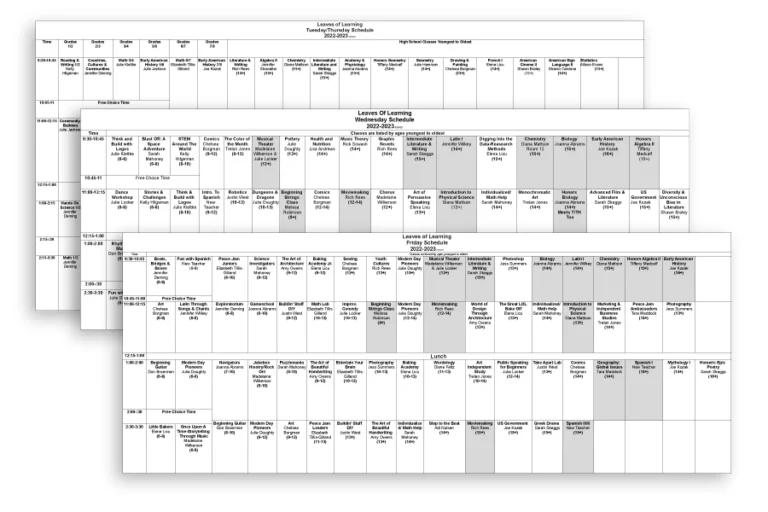
Compare all three schedules, using the tabs at the bottom to move between age groups.
View schedules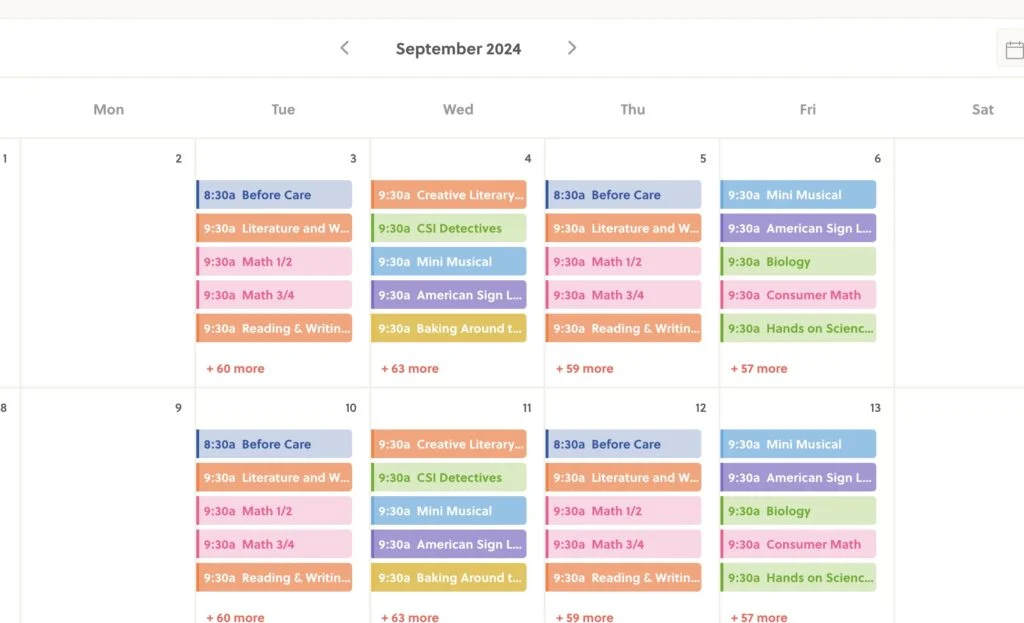
Compare classes in Sawyer
Review descriptions, meeting times, age groups, and outside-work expectations before you register.
Browse classes in Sawyer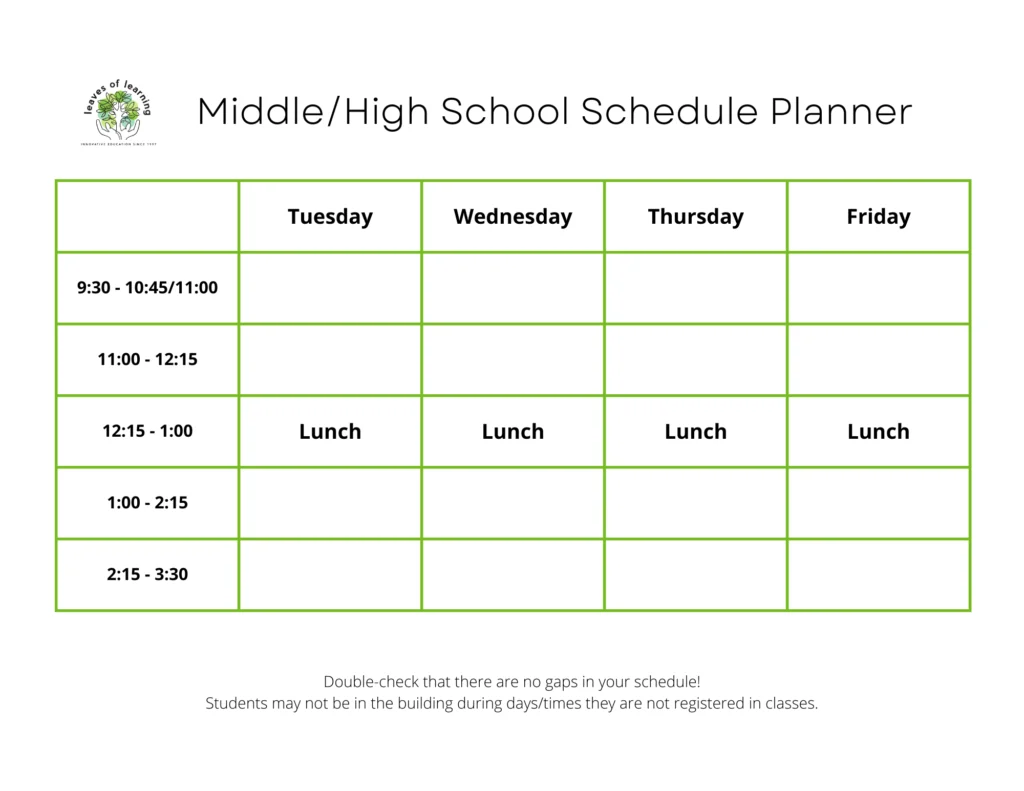
Build the week together
Use the printable planners to check travel time, open periods, and the overall weekly pace.
Download a plannerChoosing classes is the fun part
Our wide variety of classes encourages students to explore their passions and discover new ones. We recommend getting your children involved in choosing their classes; they often have interests that surprise us! Download the schedules, schedule planners, and class catalog to get started.
Compare the outside-work commitment
Teachers assign relevant outside-of-class assignments to provide students with a depth of knowledge not possible through in-class work alone. Completion of these assignments is integral to success in the class.
We ask students and parents to take the responsibility for making sure this work is completed, and we ask that each student work to the best of his/her potential. Homework expectations can be adjusted to meet the individual abilities of each of our students, and homework must be completed to remain in the class.
Please make sure you and your child are willing to make the time commitment specified in each class description. Some of our classes require little or no outside work. For these classes, any outside work is optional.


Questions families ask while choosing
Does my child need to attend all four days?
No. Families design their own program, based on each child's individual needs. Some students take only one or two classes per week while others attend all four days.
Why are core classes (science, history, math, language arts) called 1/2, 3/4, 5/6, etc.?
Our core classes (science, history, math, language arts) are called 1/2, 3/4, 5/6 and so on because these classes should be taken for both grades. Students in a multi-age core class for two years will not repeat topics. They will be revisiting concepts the second year, but at a more advanced level.
Will the same topics/material be covered both years in the multi-age classroom?
No. Students in a multi-age core class for two years will not repeat topics. They will be revisiting concepts the second year, but at a more advanced level—enabling students to learn new skills and hone old ones. Language arts classes will not repeat books over the two-year cycle. Students in the math classes will be working at the level that best meets their ability.
Science and history classes are on a topic rotation cycle. Our multi-age classes enable students to be challenged at their own level—through instruction and homework assignments that take into account their abilities and interests.
How do we choose an age group?
As an example, a child in 4th grade can choose between 3/4 and 4/5 classes. If your child is in a 3/4 class this year as a 3rd grader and doing well, then it would be best to choose a 3/4 class for the upcoming year so your child can participate in the class as a leader on a 4th grade level. There are many advantages to having multiple level classes; to fully benefit from the experience, the class should be taken for two years. If your child is working on a more advanced level and was not challenged sufficiently this year, then it may be best to sign up for the 4/5 level class.
We advise parents not to automatically assume their child should be in an older group. A child's emotional and social needs are just as important as his or her academic needs. Our small class sizes usually allow us to challenge most students. We rely on our teachers to make group change recommendations.
What if a class doesn't work out?
We want students to be happy in their classes and recognize that sometimes a class is not a fit and a change will need to be made. We encourage students to give the class a chance before making a decision. One or two days are not enough time to tell! Please give the class a chance first (four classes). If a class change is necessary, please contact Diana or Christie by email and explain the reason for the change.
Do students receive "grades"?
Students will receive a written evaluation of their work for each class they attend. These evaluations are completed twice a year—once in February and once in June—and include learning objectives for the class and information about how well these objectives were met by the student. Information about class participation, conduct, attendance, and enthusiasm will also be included.
Students in academic classes have the option to receive a letter grade in addition to the evaluation. While we hope students are motivated by the intrinsic joy of learning, we recognize that for some students, grades can be a motivator. Allowing a choice enables you to make an individual decision for each child and class.